Whisky Fact Check – Part 1
The layer of coal – the supposedly clever bouncer in the cask
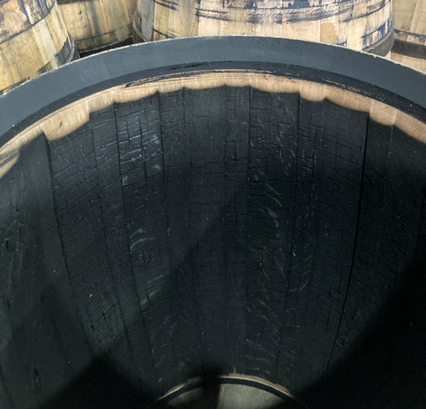
Let’s start our new fact check with this question: How does the layer of charcoal in the cask actually know which flavours to remove from the maturing new make – and which to leave in? In short: it doesn’t know. And that’s exactly what makes it so fascinating.
Introduction
The tempting notion that the char layer acts as a sort of uncompromising bouncer, turning away the immature sulphur compounds and politely waving the ‘good’ aromas through, is… well… romantic,
but wrong. The reality is less poetic – and far more scientific, or rather, physical.
But first things first. What exactly is this layer of charcoal? Well, in the process known as charring, the inner surface of the cask is heated intensely through direct contact with a flame. The
following happens: the wood components, such as cellulose, hemicellulose and lignin, are thermally decomposed, and a black layer of charcoal is formed – an aromatic material, consisting
predominantly of elemental carbon.
This charcoal is very porous; you can picture it as a sponge made up of tiny cavities. And this is where the real work begins.
Adsorption rather than ‘filtration’
An important term we need here is adsorption. With an ‘d’, not absorption with a ‘b’! Whilst in absorption (with a ‘b’) something is taken up and distributed throughout the interior, much like
water in a sponge, in adsorption (with a ‘d’) molecules attach themselves to surfaces, much like metal to a magnet.
The aforementioned charcoal has a vast internal surface area. Depending on its structure, one gram of activated carbon can have a surface area of several hundred square metres (!). This enormous
surface area is the actual ‘working space’ of the carbon layer. And that is precisely the vast playground for molecules.
Why are sulphur compounds, of all things, affected?
Many of the sulphur compounds in new make spirit that we connoisseurs perceive as ‘undesirable’ (e.g. dimethyl sulphide, mercaptans) have certain properties: They are small, often non-polar or
only weakly polar, chemically reactive and perceptible to the senses even at extremely low concentrations (ppb – parts per billion range).
Molecules with such properties have a high tendency to adhere to carbon surfaces – primarily via so-called ‘van der Waals forces’. These are not strong chemical bonds, but rather cause the sulphur compounds to ‘stick’ tenaciously to the charcoal.
So the charcoal doesn’t think: ‘Ah, sulphur – off you go!’ But rather: ‘You fit well on my surface, stay right here.’
And why do the ‘good’ aromas remain inside?
Now it gets interesting, because many of the desired aroma compounds – such as fruity esters, more complex alcohols, sugar breakdown products, vanillin, caramel compounds or coconut-like lactones
– are larger, often more polar and chemically more complex.
Some of them are already stably dissolved in the alcohol-water mixture, with ethanol in particular further inhibiting the adsorption of many larger, hydrophobic molecules onto carbon surfaces; others only form during maturation through chemical reactions in the cask. They therefore either have a lower affinity for the carbon surface or only form at a later stage, once the majority of the interfering sulphur compounds have already been adsorbed.
The carbon layer is therefore not a ‘judge’, but rather comparable to a car park with limited spaces: whoever fits in first gets to stay – and that space is then gone.
Dynamics rather than a single decision
Another point that is often overlooked: the maturation of whisky is not a one-off event, but a dynamic process that takes years. During this process, the distillate penetrates the wood of the
staves, and seasonal temperature fluctuations drive it back out again. Molecules react, break down and reform, with equilibria constantly shifting.
The charred layer acts as a buffer, removing certain substances from the system and thereby facilitating other reactions in the first place. In addition, the charred wood surface can also act as a catalyst to a limited extent, chemically altering individual compounds rather than merely retaining them.
One could also say: the char does not simply clean up – it changes the rules of the game.
Conclusion
The charcoal layer does not make any judgements about quality, but follows solely the laws of surface chemistry, molecular size, polarity and thermodynamic equilibria.
The carbon layer therefore does not know what is good or bad. It does not judge. It does not decide. It reacts. The fact that this often causes precisely the off-notes to disappear is not a plan, but a fortunate physico-chemical coincidence which we perceive sensorially as balanced, rounded and complex – and which we romantically like to regard as magic.
Perhaps that is precisely the true magic of cask maturation.