The Molecular World of Whisky – Part 3
Kilning with peat smoke
Introduction
Why does a smoky Scotch whisky taste of campfire, seaweed, or even bacon? The origin lies not in distillation or maturation in the cask, but – as is well known – much earlier: during the kilning
of the malt.
In this crucial phase of whisky production, the germinated barley grain is dried – and in this case, flavoured with peat smoke. This traditional method, found predominantly in Scotland, gives whisky its characteristic smoky, peaty aromas.
But how exactly does kilning with peat smoke work? What chemical compounds are produced in the process – and how do they shape the character of a whisky?
Origin and Significance of Kilning
After germination, the still-moist barley (i.e. green malt) must be dried in order to halt the germination process and make the malt shelf-stable. This drying takes place in so-called kilns,
where warm air is directed through the green malt.
In regions such as Islay or the Highlands, peat has traditionally been used as a fuel. When this ancient, boggy plant material is burnt, it produces a dense, aromatic smoke – and it is this which gives the malt its distinctive character.
Peat – the Aromatic Heritage of the Bogs
Peat forms over thousands of years from the decomposed remains of plants in oxygen-depleted boggy soils. Depending on the region, peat contains varying organic components such as mosses, roots,
heather, or maritime plants.
When burnt, it produces complex smoke gases containing hundreds of volatile compounds – most notably so-called phenols. These chemical compounds adhere to the moist malt grain during kilning and, to a certain extent, remain in the distillate even after the subsequent mashing, fermentation, and distillation processes.
How Smoky Malt is Made
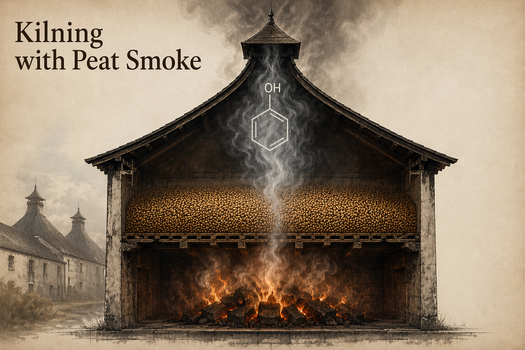
During kilning with peat smoke, the still-moist green malt is spread across a perforated floor. Below this floor sits the furnace in which the peat is burnt. The rising smoke permeates the malt
and transfers its aromas.
Three factors are decisive here:
- Duration of smoking: The longer the malt is exposed to the smoke, the more intense the flavouring.
- Moisture content of the malt: Moist malt absorbs smoke more readily than dry malt.
- Composition of the peat: Depending on the type of plant material and the area from which it was cut, the smoke character varies – from medicinal and iodine-like through earthy to smoky-bacony or leathery.
Phenols – the Aromatic Carriers of Smoke
The most important aroma compounds transferred from peat smoke to the malt belong to the group of so-called phenols.
These are chemical compounds with an interesting structure. They are based on a special ring of six carbon atoms that looks like a regular hexagon, similar to a cell in a honeycomb. Attached to one of these ring carbon atoms is a small unit called a hydroxyl group (OH group) – consisting of one oxygen (O) and one hydrogen (H) atom.
The chemical class of phenols, named after the simplest molecule in this group – phenol itself – encompasses numerous individual compounds, as various chemical groups can be attached to the other ring carbon atoms.
These various phenols are mostly liquid or melt just above room temperature, and are characterised by sufficient volatility such that their typical, often medicinal or smoky odour is clearly perceptible even in the solid state.
The most important phenols in peat smoke include:
|
Compound |
Aroma Profile |
Notes |
|
Phenol |
Medicinal, antiseptic |
Simplest phenol; detectable even in very low concentrations |
|
ortho-Cresol |
Tarry, pungent, medicinal, antiseptic |
Very low detection threshold (approx. 2–5 ppb); strongly shapes the smoky character |
|
meta-Cresol (3-methylphenol) |
Phenolic, sharp, slightly sweet |
Supports the smoky effect in the background (threshold approx. 20–30 ppb) |
|
para-Cresol (4-methylphenol) |
Stable-like, animalic, medicinal |
Contributes earthy, ‘stable-like’ notes |
|
4-Ethylphenol |
Stable-like, horse-sweat, leathery (in low doses) |
Also a component of matured cask aromas |
|
2,4-Xylenol |
Phenolic, medicinal, slightly sweet, tarry |
Complex profile with medicinal depth |
|
Guaiacol (2-methoxyphenol) |
Smoky, spicy, BBQ, slightly sweet |
Key compound for ‘campfire’ aroma; extremely low threshold (2–3 ppb) |
|
4-Methylguaiacol |
Smoky, spicy, sweet, slightly vanilla-like, mildly medicinal |
Provides mild, harmonious smoky notes |
|
4-Ethylguaiacol |
Sweet, soft, lightly caramel-like |
Softens the smoke; imparts roundness and pleasantness – threshold approx. 40–60 ppb |
|
4-Vinylguaiacol |
Spicy, clove-like, sharp |
Spicier than 4-ethylguaiacol; reminiscent of cloves |
|
Syringol (2,6-dimethoxyphenol) |
Sweetly smoky, balsamic, faintly vanilla-like |
Frequently found in milder smoky aromas |
|
Eugenol |
Clove-like, warmly spicy |
Also derived from the cask (lignin breakdown); contributes to spiciness |
|
ppb = parts per billion |
||
All of these compounds are highly volatile and strongly aromatic even in minute quantities. Guaiacol and ortho-cresol are detectable at extremely low concentrations, which is why they exert a particularly strong influence on the aroma of a whisky even when present in small amounts.
Meta-cresol and 4-ethylguaiacol, on the other hand, need to be present in higher concentrations to be perceived. They often act as supporting nuances in the background.
It should be noted, however, that individual odour detection thresholds vary genetically – that is, from person to person. Whilst some people perceive guaiacol as pleasantly smoky, others find
the smell more acrid.

Measuring Phenol Content – the Unit “ppm”
The content of phenolic compounds in malt is typically measured in ppm (parts per million). There are two common analytical methods.
Colorimetry is the simpler method, in which phenols react with an added reagent to produce a colour, the intensity of which is measured in a specialist analytical instrument. This method gives only the total phenol content.
HPLC (High Performance Liquid Chromatography) is the more precise analytical method, by which individual phenols can be separated and quantified. It is now regarded as the standard in the Scottish whisky industry.
The rule of thumb is: the higher the ppm value, the smokier the base malt. However, the actual smoke content in the finished whisky is not identical to the ppm value of the malt used. This is because during whisky production – that is, during mashing, fermentation, distillation, and cask maturation – large portions of the volatile phenols are lost.
The specialist literature suggests that only approximately one third of the original quantity of phenols in the malt ultimately ends up in the finished whisky.
How Peat Influences Aroma
Not all peat is the same. The origin, plant composition, and depth of the peat layer from which it was cut all influence the aroma profile of the smoke when the peat is burnt:
- Islay peat (rich in heather, algae, and other maritime plants) → Intensely smoky, iodine-like, medicinal, with seaweed notes
- Orkney peat (predominantly heather, minimal maritime influence) → Lightly smoky, herbal, gently earthy
- Speyside peat (high proportion of wood residues and broad-leaved plants) → Sweet, mildly smoky, reminiscent of pipe tobacco or sweet wood
- St. Fergus peat (rich in phenol-heavy, spicy plant matter) → Spicy, powerfully smoky, with robust phenolic notes
The combustion temperature of the peat also influences which phenols are preferentially produced.
At higher temperatures, around 750°C, phenol and cresols are formed in greater quantities, leading to more medicinal, antiseptic notes in the aroma.
At lower temperatures, around 400°C, guaiacol and syringol are produced in greater amounts, which are responsible for sweetly smoky notes.
What Happens During Maturation?
Many phenols remain in the distillate even during years of maturation in oak casks. In addition, new phenolic compounds enter the whisky from the wood – particularly through the charring of the
casks.
During this process, the natural wood component lignin is broken down by heat into smaller aromatic molecules. Some of these compounds, in particular 4-ethylphenol and 4-vinylphenol, impart sweet, smoky, and woody notes to the whisky.
Eugenol provides a spicy quality reminiscent of cloves. These aroma compounds can lend the whisky a smoky depth – even when no peat smoke was used during production.
Influence on the Later Flavour Profile
Phenols are extremely formative of a whisky’s character. They can smell and taste medicinal, smoky, bacony, earthy, or even maritime.
In combination with other aromas – such as those from the oak cask (e.g. vanillin) or from Maillard reactions during kilning – multi-layered flavour experiences arise that are particularly characteristic of peaty whiskies.
The smoke in a whisky does not dissipate entirely over the years, but rather changes – becoming rounder, sweeter, and better integrated.
Conclusion
Kilning with peat smoke is an ancient, fascinating technique of whisky production that fundamentally determines whether a whisky will be smoky or mild.
The phenolic compounds produced in the process shape the aroma for years to come – and make smoky whiskies true characters with a recognisable signature.
In many regions of Scotland, this method of drying is deeply rooted to this day and is regarded as a proud tradition that gives particularly bold, expressive whiskies their unmistakable style.
Those who appreciate the taste of campfire, seaweed, or smoked bacon in the glass owe that pleasure above all to a single stage of the process: kilning with peat smoke.