The Molecular World of Whisky – Part 6
The Mysterious Reactions Inside the Pot Still
What actually happens during distillation inside the pot still?
Anyone who assumes that the process merely separates the heavier, less volatile water from the lighter, more volatile alcohol ethanol is only seeing half the picture. For within the copper walls of the pot still – where steam meets metal – mysterious things take place that we shall explore in this article.
The pot still is far more than a simple physical separation apparatus. Inside it, a veritable spectacle of aromas unfolds: unwanted compounds disappear, new flavours emerge – and the multifaceted foundation of the future whisky is laid, even before a cask enters the equation.
It is the interplay of heat, copper, and molecules that refines the new make spirit. Welcome to the innermost laboratory of whisky production!
Distillation – more than mere separation
It all begins with the wash – a beer-like liquid containing roughly 7-10% alcohol by volume (ABV). Inside the pot still it is heated, and it is here that the classic separation occurs: alcohol
vaporises at lower temperatures than water, rises as vapour, is condensed and collected.
After two distillation runs – first in the wash still, then in the spirit still – what remains is the so-called middle cut, also known as the “hearts.” With an alcohol content well above 60% ABV, this is the foundation for subsequent maturation in oak casks.
Yet what unfolds inside the pot still is far more than mere physics. This is where the magic of flavour begins.
Copper – the unsung hero of good flavour
Anyone who has ever seen a pot still will know: copper (Cu) is the dominant material in traditional pot stills.
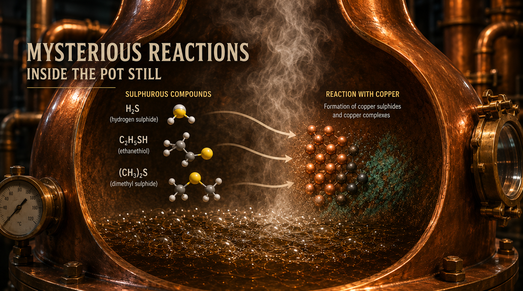
Yet this reddish-gold gleaming metal is valued not merely for its excellent thermal conductivity – it is also chemically highly reactive. Copper binds sulphurous compounds that form during fermentation from sulphur-containing amino acids such as cysteine and methionine, and which are reminiscent of rotten eggs, boiled vegetables, or worse – decidedly unpleasant.
Examples include hydrogen sulphide (H₂S), sulphur dioxide (SO₂), ethanethiol (C₂H5SH), dimethyl sulphide (DMS), dimethyl disulphide (DMDS), and dimethyl trisulphide (DMTS).
These compounds are, in a sense, rendered olfactorily harmless: they react with the copper surface to form low-volatility copper sulphides or copper complexes. These salts deposit on the still walls and do not carry over into the distillate.
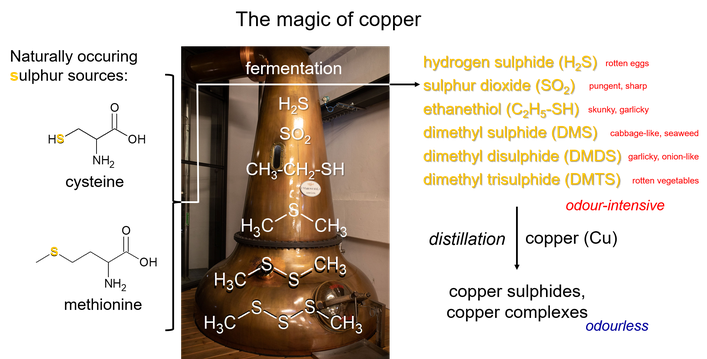
The longer the vapour remains in contact with copper – for instance during a slow distillation or in a tall still – the more pronounced this cleansing effect.
The result is a cleaner, more elegant distillate with fewer intrusive sulphurous notes.
How sulphur aromas arise nonetheless – and are sometimes even desirable
From a scientific perspective, the world of sulphur compounds is extraordinarily complex. Some form only during distillation, driven by heat – whilst others break down or transform in the
process.
Studies have shown that DMDS and DMTS actually increase during distillation and are further promoted by higher temperatures and longer distillation times. Some of these sulphur compounds, in minute quantities, can nonetheless enrich a whisky – particularly in peated expressions, where they contribute a spicy or smoky depth.
As so often: the dose makes the difference.
Reactions in equilibrium – a molecule rarely acts alone
Some of the chemical reactions inside the pot still do not simply proceed from A to B, but instead establish an equilibrium – represented by the double-headed arrow (⇌). This means the reaction
can in principle proceed in both directions.
The determining factors are conditions such as temperature, alcohol content, or water proportion. In practice, the equilibrium generally shifts markedly in favour of the desired aromas – a fortuitous outcome for the resulting whisky.
Acids and alcohols – when esters define the flavour profile
Alongside these cleansing processes, another chemical drama unfolds: esterification. Here, alcohols – most notably ethanol – react with organic acids to form so-called esters, aromatic compounds
that often impart fruity nuances.
They define the flavour profile of many whiskies – for example banana (isoamyl acetate), apple (ethyl acetate), or pear (propyl acetate):
Acid + Alcohol ⇌ Ester + Water
The diversity of alcohols and acids present gives rise to a complex mixture of esters that fundamentally shapes the character of the future whisky.
Transesterification: molecular rearrangement in hot vapour
During distillation, transesterification can also occur – that is, the conversion of an existing ester into a new one through the exchange of the alcohol or acid group.
This process proceeds with particular efficiency under heat and in an alcoholic environment.
Example:
Ethyl acetate + Isoamyl alcohol ⇌ Isoamyl acetate + Ethanol
The result is a dynamically shifting ester profile during distillation – an invisible interplay of molecules that contributes to the ultimate complexity of the spirit.
Acetal formation – floral and sweet accents
Within the steaming alcoholic mixture, aldehydes (highly reactive intermediate compounds formed, for instance, during the breakdown of sugars) can combine with alcohols to form so-called
hemiacetals and acetals – compounds well known for their floral and sweet aromas:
Acetaldehyde + Ethanol ⇌ 1-Ethoxyethanol (a hemiacetal)
Acetaldehyde + 2 Ethanol ⇌ 1,1-Diethoxyethane (an acetal)
These acetals introduce floral or sweetish notes into the distillate, reminiscent of wine or honey – subtle, delicate nuances that collectively contribute to elegance.
A special case: directly fired pot stills
Most Scottish distilleries today employ indirect steam heating, which brings the wash uniformly to around 100 °C. A handful – including Springbank and Glenfarclas – continue to use direct firing
of their pot stills with gas or open flame.
What may seem archaic has a decisive effect: localised hot spots on the copper base of the still. There, temperatures can rise well above 150 °C – particularly when residues such as sugars, amino
acids, or yeast particles settle and scorch.
And it is precisely here that things become chemically fascinating:
Maillard reactions
Where sugars and amino acids meet under heat, the Maillard reaction can occur – that complex, non-enzymatic browning reaction responsible for the characteristic colour and savoury aroma when
bread is toasted or meat is browned.
The result: malty, bready, and lightly meaty aromas that lend depth to the final spirit.
Caramelisation
Sugars themselves can also caramelise at these temperatures. Through the reaction of sugar with sugar – a process that proceeds without the involvement of amino acids – bittersweet aromas such as
furanones or HMF (5-hydroxymethylfurfural) are formed, reminiscent of roasted nuts, almonds, or browned sugar.
Strecker degradation
Acting in concert with the Maillard reaction, the so-called Strecker degradation of amino acids can also occur, named after the German chemist Adolph Strecker.
This is a process in which heat generates small, aromatically potent molecules such as methional (boiled potato), isovaleraldehyde (malty, nutty), or phenylacetaldehyde (floral, honey-like). These belong to the class of aldehydes and contribute significantly to the aroma.
Aromatic impact
What distinguishes direct firing? Bolder, spicier, more profound distillates that are capable of developing particularly complex aromas during cask maturation.
In the hands of an experienced stillman, the flame becomes an instrument – deliberately controlled in pursuit of greater character.
Heat as the catalyst of flavour
What unites all these processes is the elevated temperature inside the pot still. It sets chemical reactions in motion that would barely occur, or not occur at all, at room temperature.
In this way, the pot still becomes a flavour laboratory in which the future taste profile is already being shaped long before the cask plays any role.
Conclusion: the pot still as alchemist
During distillation, far more takes place than mere “evaporation and collection.”
Within the pot still, numerous chemical reactions are at work – some helping to eliminate unwanted aromas, others directly contributing to the complexity of the whisky. The pot still does not merely separate – it shapes, refines, and composes the sensory foundation.
Anyone who delves deeper into whisky production will come to recognise: whisky is not made solely in the cask – it begins with heat, metal, and molecules in the very heart of the pot still.