The Molecular World of Whisky – Part 4
Enzymes at work
Introduction
How does cereal starch become fermentable sugar?
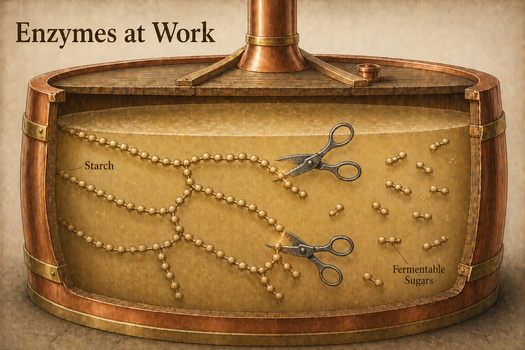
The answer lies in the activity of highly specialised enzymes that begin their work during mashing. These biological catalysts break down complex plant starch step by step – and in doing so, create the prerequisite for the subsequent alcoholic fermentation.
Without enzymes, there would be no whisky and no beer – at least not of the quality we know today. They work invisibly in the background, are temperature-dependent, and highly selective in their function.
But what exactly happens during enzymatic starch breakdown? Which enzymes are involved, and how do they work? And what conditions must be present for these little helpers to reach their full
potential?
A closer look at the biochemical processes in the mash tun reveals that nature has devised a system for this process that is as elegant as it is efficient – and one that is well worth examining
more closely.
Starch – the Plant’s Energy Reserve
Let us begin at the starting point – starch. In barley, as in all cereal grains, the energy-providing sugar is present in a bound form as starch.
Starch is a polysaccharide – a multiple sugar – made up of many glucose molecules (C₆H₁₂O₆) linked together in a chain. Starch accounts for approximately 65% of the barley grain and serves as the
plant’s energy store.
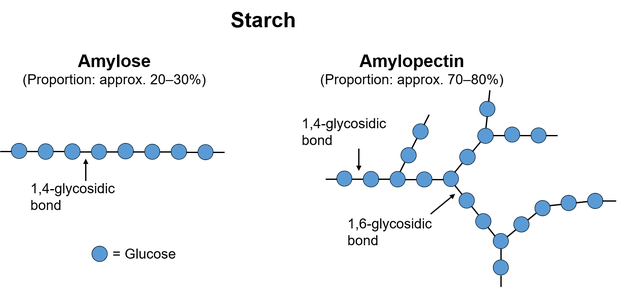
Depending on how the individual glucose units are connected to one another, two main components of starch can be distinguished: amylose and amylopectin.
Amylose consists of long, spirally coiled chains – similar to a string of pearls – in which the glucose building blocks are linked via so-called 1,4-glycosidic bonds.
Amylopectin, by contrast, forms a complex, highly branched network. Here, 1,6-glycosidic bonds also come into play, enabling branch points at certain positions along the chain.
In starch, the ratio of the two components is approximately 1:4, i.e. roughly 20-30% amylose and 70-80% amylopectin. The precise ratio may vary slightly depending on the barley variety and malt quality.
Starch Granules – the ‘Sugar Armour’
In the barley grain, starch is present in the form of so-called starch granules – tiny ‘starch spheres’ surrounded by a protective cellulose shell and embedded in a protein matrix.
These barriers must first be overcome in order to access the starch – and thereby the sugar. And this is precisely where nature’s tools come into play: the enzymes.
How Do Enzymes Work? – A Simple Explanation
Enzymes are the ‘invisible helpers’ of biochemistry: they assist in making chemical reactions – such as those during mashing – proceed more rapidly, without being consumed in the process.
Technically speaking, they are known as biological catalysts. They consist of protein molecules and are highly specialised.
A useful analogy for understanding enzymes is the nutcracker comparison: imagine trying to crack nuts. Without a tool, it is laborious – with a nutcracker, it is much faster. The nutcracker
itself remains unchanged, no matter how many nuts are cracked with it. This is precisely how an enzyme works: it helps to accelerate a specific reaction whilst remaining unaltered.
If you only have one nutcracker, it naturally takes a while to crack all the nuts. With many nutcrackers, the job is done more quickly. Equally, the more enzymes are present, the faster the
biochemical reaction proceeds.
However, not every nutcracker is suitable for every nut – one designed for Brazil nuts will not necessarily work for walnuts. In the same way, enzymes are highly specialised: each enzyme is
tailored to a very specific task. It can only convert a particular compound.
The Lock-and-Key Principle
Another key principle of biochemistry explains why this is the case: the so-called lock-and-key principle. Enzymes possess a precisely folded, three-dimensional structure with a specialised
‘binding pocket’ – the active site. Only one specific molecule, the so-called substrate, fits into this site, like a key into a lock.
During mashing, this substrate is starch – more precisely, its two main components: amylose and amylopectin. The matching ‘keys’, i.e. enzymes, are for example α-amylase, β-amylase,
α-glucosidase, and limit dextrinase. Each of these enzymes can only cleave very specific bonds within the starch molecules – and only when the structure fits exactly.
Thus, α-amylase ‘recognises’ internal 1,4-glycosidic bonds within the chain, whilst limit dextrinase is specialised in the 1,6-branch points in amylopectin. Only when substrate and enzyme are a
perfect match can the reaction take place.
Incidentally, most enzymes can be recognised by their suffix ‘-ase’ – for instance amylase (which breaks down starch) or protease (which cleaves proteins).
What Happens During Mashing?
Mashing is the process by which the milled malt (grist) is converted into a sugar-rich, fermentable liquid – the wort. To this end, the malt grains are broken apart using roller mills in order to
increase the surface area for contact with the hot mashing water.
During mashing, soluble substances such as vitamins, minerals, and free sugars are transferred directly into the water. Insoluble components – primarily proteins and starch – must instead be broken down by enzymes into smaller, water-soluble building blocks.
The heat causes the starch in the grains to swell initially, and then to gelatinise – meaning that its crystalline structure dissolves and it becomes accessible to water and enzymes. At the same
time, the enzymes are activated and progressively break the starch down into fermentable sugars.
The Four Principal Agents of Starch Breakdown
The aim of mashing is to convert the starch as completely as possible into sugars that the yeast can subsequently transform into alcohol.
Four enzymes play the leading roles in this process. They work in concert and systematically break down the starch:
|
Enzyme |
Action |
Temperature optimum |
|
α-Amylase |
Cleaves starch molecules internally, producing smaller fragments (e.g. dextrins). |
68-72 °C |
|
β-Amylase |
Removes two glucose units at a time (maltose) from the chain end – up to the first branch point. |
60-65 °C |
|
Limit dextrinase |
Cleaves the branch points in amylopectin, creating new points of attack for other enzymes. |
55-60 °C |
|
α-Glucosidase |
Cleaves individual glucose molecules from the chain end. |
55-60 °C |
Outside these temperature ranges, the enzymes still exhibit activity, though with reduced efficiency.
Optimal Conditions for Enzymatic Activity
For the enzymes to work efficiently, the conditions must be right. The ideal temperature generally lies between 63°C and 65°C, with a contact time of 30 to 60 minutes. Within this range, the
starch begins to swell and gelatinise irreversibly, which greatly facilitates enzymatic access.
This phase is where the majority of starch breakdown takes place. At higher temperatures, such as those occurring in later mashing stages, the starch granules may break apart entirely. The crystalline structure is then completely destroyed – a process referred to as complete gelatinisation.
Only heat-resistant enzymes, in particular α-amylase, are then able to continue breaking down the remaining starch.
The Result: Sugar for the Yeast
Under ideal conditions, mashing converts starch into fermentable sugars, which the yeast subsequently transforms into ethanol and CO₂. These include principally:
- Glucose (monosaccharide)
- Maltose (disaccharide composed of two glucose units)
- Maltotriose (trisaccharide composed of three glucose units)
These types of sugar are particularly important for fermentation, as they can be metabolised directly by the yeast. Approximately 75-80% of the original starch can be converted into fermentable sugars in this way.
The remainder is present in the form of dextrins – longer glucose chains that can no longer be broken down by yeast. These remain after distillation in the wash still as a component of the pot ale.

Conclusion
The biochemical breakdown of starch is a highly specialised process made possible by natural enzymes. It forms the very heart of the mashing process and provides the raw material for subsequent
fermentation: sugar.
Only when the enzymes can work under optimal conditions is a high-quality, fermentable sugar profile produced – and with it, the foundation for expressive whiskies.
The targeted breakdown of starch is a prime example of how biochemistry and artisanal skill go hand in hand in the world of fine spirits.