The Molecular World of Whisky – Part 2
The Maillard Reaction
Introduction
Why do freshly toasted bread, roasted meat, or a matured whisky smell so enticing?
The answer lies in a fascinating chemical reaction that creates aromas and pigments – the Maillard reaction. In whisky production, it contributes significantly to the development of the flavour profile and influences many of the characteristic aromas and colour nuances.
But when exactly does the Maillard reaction occur during the production process? Which chemical compounds are formed, and how do they shape the taste of the whisky?
Origin and Naming
The reaction was named after the French physician and chemist Louis-Camille Maillard (1878–1936). At the beginning of the 20th century, he investigated how amino acids – the small building blocks
the body uses to form protein – react with sugars to better understand the chemical processes within the human organism.
In 1912, Maillard published his first results, describing the formation of brown compounds when heating amino acids and sugars. His work laid the foundation for understanding flavour development in many cooking processes and food manufacturing.
What is the Maillard Reaction?
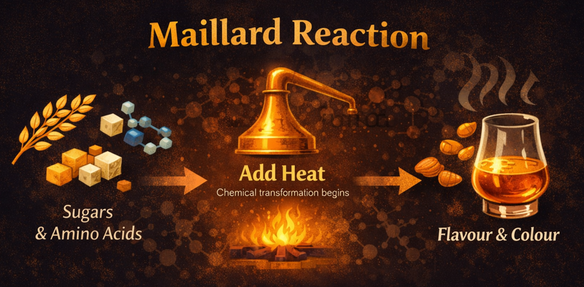
The Maillard reaction is a so-called "non-enzymatic browning reaction" that occurs without the use of enzymes. It takes place between amino acids and reducing sugars, such as glucose or fructose.
This creates a wide variety of colour and aroma substances. While high temperatures of around 140 °C accelerate the reaction, it can also take place at lower temperatures – just more slowly.
Where does the Maillard reaction occur in whisky production?
The Maillard reaction influences the aroma of whisky at several stages of the production process, particularly where heat plays a role:
(1) Kilning the malt
During the drying of the germinated grain in kilns, numerous Maillard products are created by the heat. This effect is particularly intense when peat smoke is used, as it adds phenolic
aromas.
2) Mashing the grist
During mashing, enzymatic processes convert starch into sugar and proteins into amino acids (please refer to part 1: The malting of barley). Although temperatures here are lower than during
kilning or distillation, the first slow Maillard reactions still take place, forming aroma precursors.
(3) Distillation
During distillation, the application of heat leads to further Maillard reactions – especially when the copper pot stills are directly fired (e.g., at Glenfiddich, Yamazaki). Higher temperatures
and hot surfaces favour these reactions between amino acids and sugars.
(4) Thermal treatment of the casks
The toasting and charring of the oak casks also produce aromatic and coloured Maillard products. Here, the sugars released in the wood react with the proteins also present in the oak under the
influence of heat. During maturation, the distillate extracts these compounds from the wood, leading to the development of complex aromas.
Chemical products of the Maillard reaction and their aromas
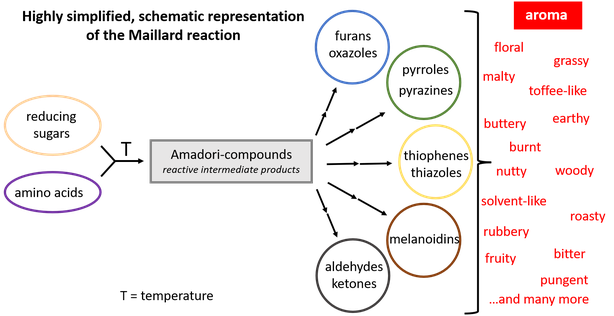
The Maillard reaction proceeds in several stages, initially forming highly reactive intermediates known as Amadori compounds (named after the chemist Mario Amadori). These unstable molecules,
which exist only briefly and change rapidly, transform further to create a multitude of aroma substances.
Although these occur only in very small quantities (between 1 μg/kg and 1 mg/kg), they significantly shape the whisky's flavour profile due to their low odour threshold.
The most important aroma substances and their effects
The aroma substances resulting from the Maillard reaction consist mainly of carbonyl compounds (including aldehydes and ketones) and heterocyclic compounds.
These are chemical substances formed from carbon atoms into rings (usually five- or six-membered rings), where one or more carbon atoms in the ring are typically replaced by atoms such as nitrogen, oxygen, or sulphur. Some examples are listed below:
- Furans (carbon ring with oxygen): caramel and toffee aromas
- Oxazoles (carbon ring with oxygen and nitrogen): spicy, roasted, and slightly cocoa-like notes
- Pyrroles, Pyrazines (carbon ring with nitrogen): nutty, roasted notes, bacon aromas
- Thiophenes (carbon ring with sulphur): spicy, meaty notes
- Thiazoles (carbon ring with sulphur and nitrogen): spicy, roasted notes, slightly bread-like aromas
- Melanoidins: yellow-brown to black compounds responsible for the colour
- Aldehydes (e.g., isovaleraldehyde): malty, cereal notes
- Ketones (e.g., diacetyl): buttery, creamy notes
Analyses show that pale malt types predominantly form oxygen-containing ring compounds (furans), which provide toffee and caramel aromas. In contrast, dark malt types, which were heated more
intensely during kilning, contain larger amounts of nitrogen-containing Maillard products (pyrroles, pyrazines) that enhance nutty aromas.
Complexity of the Maillard Reaction
Depending on the starting materials, the reaction of amino acids with sugars produces a vast number of compounds.
For instance, 24 different compounds have already been identified in the reaction of glucose with the amino acid glycine.
With xylose – a sugar naturally found in wood – and glycine, over 100 Maillard products could be detected. This enormous variety explains the depth and complexity of aromas in whisky.
The Maillard Reaction in Everyday Life
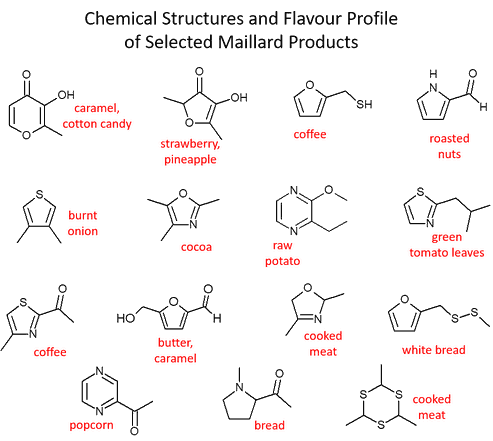
It is not just whisky that owes its aromas to the Maillard reaction; we encounter it daily in numerous foods:
- Baking bread: The crust gets its golden-brown colour and typical aroma through the reaction between flour proteins and sugars.
- Coffee and cocoa roasting: The intense roasted aromas are created by Maillard products.
- Searing meat: The appetising browning and umami taste of fried steaks are results of the Maillard reaction.
- Roasted nuts and potatoes: This is where typical roasted and caramel notes are formed.
The same reaction that makes a steak delicious also provides the deep, caramelly notes in a whisky matured in toasted casks.
Conclusion
The Maillard reaction is a key factor in whisky production, controlled by heat, time, and raw materials. It significantly influences the sensory properties of the final product and contributes to
the diversity of whisky aromas.
Its origin dates back to the research of Louis-Camille Maillard, but its significance goes far beyond science – it connects chemistry with pleasure and plays a central role in the world of food and drink.