The Molecular World of Whisky – Part 5
Ethanol out of pure survival instinct
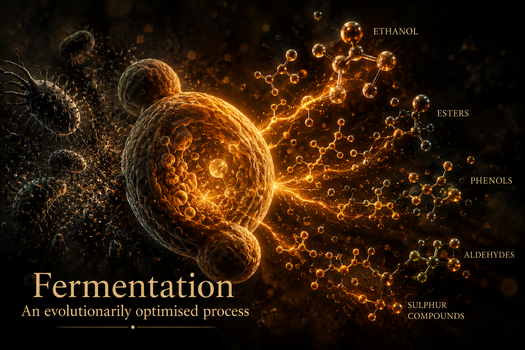
Why does yeast produce alcohol during fermentation – or more precisely: ethanol? Hardly to provide humans with beer, wine, or whisky.
In fact, the origin of this biochemical achievement lies in a deeply rooted survival mechanism. But that is not all: alongside ethanol, numerous other compounds – so-called congeners – are produced during fermentation, and these significantly shape the aroma and character of a whisky.
Coincidence? Not at all. What we experience as pleasure is the result of millions of years of evolutionary optimisation.
Why does yeast produce ethanol at all?
The answer begins with the fundamental need of every living organism: energy. The single-celled yeast Saccharomyces cerevisiae – the most important micro-organism in whisky production – obtains
energy from sugar, preferably glucose.
Under oxygen-rich conditions, it uses the most efficient pathway: aerobic cellular respiration. From a single molecule of glucose, up to 38 molecules of ATP (adenosine triphosphate), the “energy currency” of the cell, are produced.
As soon as oxygen becomes scarce – as in a sealed fermentation vessel – yeast switches to alcoholic fermentation. This anaerobic alternative yields only 2 ATP per glucose molecule. In order to
generate sufficient energy nonetheless, yeast must metabolise large quantities of sugar. The result is ethanol – not for pleasure, but out of biochemical necessity.
The Crabtree effect – when sugar overrides oxygen
A remarkable metabolic mechanism of yeast is the so-called Crabtree effect, named after the British biochemist Herbert G. Crabtree.
It describes the phenomenon whereby Saccharomyces cerevisiae begins producing ethanol even at high sugar concentrations – even when oxygen is still present. In this case, yeast “chooses” the faster fermentation over the more efficient respiration.
Why? Because it thereby gains ATP more rapidly – and simultaneously deploys ethanol as a weapon: a toxic by-product that inhibits or eliminates competing micro-organisms. The Crabtree effect is
therefore not a malfunction, but a clear survival advantage.
The true reason for alcohol production: redox balance
A critical aspect of fermentation is the redox balance within the cell. During glycolysis – the first step of biochemical sugar breakdown – the coenzyme NAD⁺ is reduced to NADH. To prevent
metabolism from coming to a standstill, NAD⁺ must be rapidly regenerated.
This is achieved by converting pyruvate – an important intermediate product of glycolysis – into acetaldehyde and ultimately into ethanol. In doing so, NADH is oxidised back to NAD⁺ and thus regenerated. Ethanol is therefore not merely a by-product, but a functional component of cellular balance.
For us, it is the primary product – for yeast, however, it is a solution to its biochemical recycling problem.

Ethanol as a biological weapon
What begins as an emergency solution becomes an evolutionary strategy. Ethanol is toxic, particularly to bacteria and other micro-organisms. In sugar-rich environments teeming with microbial life
– such as overripe fruit – yeast gains a clear selective advantage through ethanol production.
It creates a milieu that remains hospitable to itself, yet is lethal to many competitors. In this way, “food rivals” are efficiently eliminated, and alcoholic fermentation becomes a microbial
defence strategy.
Why is ethanol not the only product?
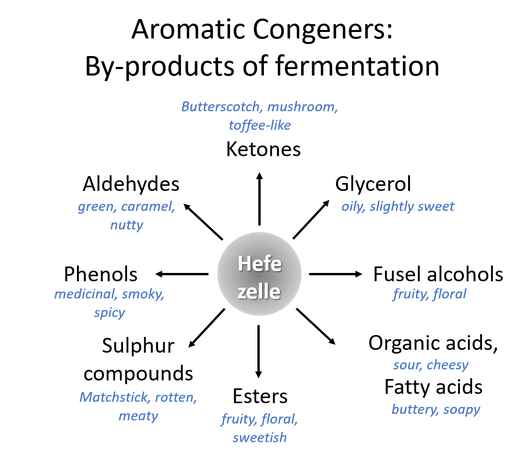
The fermentation process yields a remarkable variety of by-products – from glycerol and higher alcohols through to fruity esters. These congeners contribute significantly to the aromatic profile
of a whisky.
The reason lies in the nature of cellular metabolism: rather than following a linear sequence, it resembles a branching network in which many intermediate products diverge in different directions
at so-called metabolic junctions – releasing a range of aroma-active substances in the process.
Glycerol – protection under stress
A classic example is glycerol, which is produced in response to osmotic stress – such as at high sugar concentrations. It stabilises the water balance and protects proteins. The formation of
glycerol contributes to maintaining redox balance by oxidising NADH back to NAD⁺.
In the final whisky, very little glycerol remains – its high boiling point prevents it from being carried over during distillation. It is not a direct aroma carrier, but rather an indicator of
healthy fermentation that contributes to aromatic diversity.
Higher alcohols – floral notes and fruity weight
In addition to sugar, yeast also metabolises amino acids – the building blocks of proteins. It primarily utilises their nitrogen component. Via the so-called Ehrlich pathway – named after the
German biochemist Felix Ehrlich – higher alcohols are produced within the cell, such as isoamyl alcohol (banana aroma) or phenylethanol (rose fragrance), which are then released into the
surrounding environment.
At low concentrations, these compounds – known as fusel alcohols or fusel oils – enrich the aromatic profile; at high concentrations, they taste harsh and may cause headaches – hence the name
fusel alcohols. Here too, what appears to be a by-product is in fact the result of intelligent cellular architecture.
Organic acids, fatty acids – and the birth of esters
To build its cell membrane, yeast produces short-chain organic acids, from which longer-chain fatty acids are subsequently formed. These are either incorporated into the membrane or excreted. The
release of these acids also helps to lower the pH of the surrounding environment – an important defence mechanism against unwanted microbes.
When these acids encounter alcohols, enzymatic esterification produces a particularly important class of aroma compounds: esters. Esters are true stars amongst fermentation by-products – they smell fruity, floral, or sweet and lend the new make spirit its freshness and complexity.
Esters do not merely serve as “aroma donors”; they also fulfil cellular detoxification functions – a prime example of biochemical dual action.
Sulphur compounds – spicy tension
During fermentation, sulphur-containing amino acids such as cysteine and methionine give rise to sulphur compounds – for example, hydrogen sulphide (H₂S) or sulphur-containing alcohols known as
thiols.
Even in trace amounts, these compounds are highly intense: putrid, meaty, pungent. In controlled doses, they lend the whisky depth and complexity – comparable to nutmeg or pepper in cooking. When
uncontrolled, however, they severely disrupt the aromatic profile.
Phenols – smoke and depth
Phenols such as guaiacol or cresols are produced primarily during the processing of peated malt, but can also be formed by yeast itself – from aromatic amino acids.
They impart smoky, medicinal, or spicy notes to the whisky. Even in unpeated spirits, trace quantities of phenolic compounds can add subtle depth.
Aldehydes – fruity and nutty aroma donors
Aldehydes are produced both during fermentation and through oxidative processes during maturation. At low concentrations, they contribute aromas such as green apple (acetaldehyde), caramel, or
nuts.
They arise from amino acid breakdown or through oxidative stress – and add distinctive top notes to the aromatic spectrum.
Ketones – creamy aromatic accents
Ketones such as diacetyl, octen-3-one, or HDMF (4-hydroxy-2,5-dimethylfuranone) are produced through amino acid breakdown, lipid oxidation, or already during the malting process. Diacetyl imparts
creamy buttery notes, HDMF is reminiscent of toffee, and octen-3-one delivers mushroom-like, earthy tones.
These compounds lend the whisky softness, fullness, and depth – often underestimated, yet crucial for the mouthfeel.
Conclusion
Alcoholic fermentation is far more than merely an intermediate step on the way to distillation. It is a highly complex, evolutionarily optimised process in which ethanol and numerous by-products
are formed – not by chance, but out of pure survival instinct on the part of yeast.
What represents survival for the yeast is pleasure for us: fruity esters, floral alcohols, subtle acids, spicy sulphur compounds, smoky phenols, green aldehydes, and creamy ketones – all of them shaping the sensory profile of a whisky.
Fermentation is an orchestrated interplay of molecular strategies – a biochemical masterpiece that transforms sugar into not merely alcohol, but an entire world of aromas.